Our main purpose for going to Seoul when Tom and Mike came was to have a tour of the DMZ (De-Militarized Zone) and JSA (Joint Security Area). I found the tour online through tourdmz.com It was the only company I could find that offered a tour of both areas on a Saturday at a price I was willing to pay.
Pickup was at 8:30 at the Lotte Hotel. Lotte is one of the largest brands, and had a gorgeous hotel in downtown Seoul. The tour was about half English speakers and half Japanese speakers. There weren't any Koreans on the tour because as a Korean you are not allowed to have a tour of the DMZ.
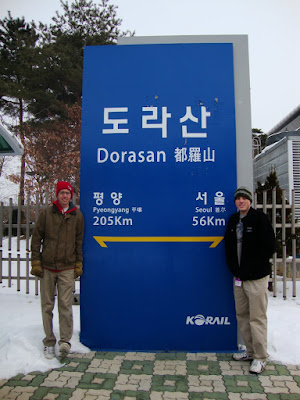
Our first stop was Dorasan Station. It is the northern-most train station and very, very close to NK. They have the line set to go to NK, but due to the current political situation, the project is still in the works. Once the project is complete, the line will run from Busan all the way through Russia and over to Europe, making it the longest train line. The station was also brand new and completely empty. Guess it doesn't get much use! Here are the boys in front on the empty platform:
Our next stop was the Dora Observatory. From this point, you usually have a good view into the DMZ and North Korea. However, our weather was cloudy and with the snow it was really hard to tell what we were looking at. I imagine on a nice summer day you'd have a pretty good view.
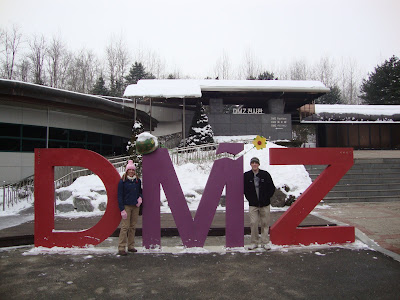
Close by is the third tunnel. It was one of 4 (known) tunnels dug from the north to invade the south. Luckily, they discovered it in time! You aren't allowed to take pictures in the tunnel for security purposes. We were able to go quite far into the tunnel after taking the monorail down into it (it was just like a rollercoaster!) and they provided us with hard hats because the ceiling was low. Mike and Tom kept hitting their heads on the rock but I managed to only hit mine a few times. In the tunnel, we were able to go pretty close to the Military Demarcation Line, so that was exciting. It was suprisingly warm 73 meters under the surface, I was getting pretty cold from being outside! Outside the tunnel we went into some visitors sections and took this picture:
Then we went to Imjingak freedom village. There is a long bridge that goes into the DMZ where the POW's were exhanged after the war. We looked at some monuments and got to walk on the bridge a little. It was covered with ribbons everywhere you looked, I'm assuming to honor those families that were/still are separated. There was also a train here that had been derailed by bombs at some point during the war. There were over 1,020 bullet holes in it and according to the sign, it "shows the cruel situation at the time."
This is Tom with the ribbons on the bridge:

Another thing that was interesting was the two layer wire fence. It looked like one giant booby trap. There were rocks stacked in the wire and each type of rock had a different name (Auditory stone, Hearing stone, Patrol tag, and Trace stone). They are supposed to alert the guards that patrol the barrier if there was an intruder because of the way they are stacked. I couldn't believe the amount of barbed wired on the fence!
We switched busses at this point to take the second half of our tour, the JSA portion. This might be a little hard to describe how everything felt and what it looked like, so forgive me if it is a little confusing.
In our new bus we drove to Camp Bonifas which is just on the southern border of the DMZ. Our tour guide was telling us about the "lucky" young men that get to do their now 18-month mandatory military service there. It is very prestigious. They have to meet a height limit, be physically and mentally tough, speak 4 languages (though I'm not sure how well), and be at least a black belt in Taekwondo. Now, I'm not sure if that is correct because during the tour, Tom, Mike, and I all thought we heard different things about the requirements.
Camp Bonifas looked like what I assume any other military base does. We weren't allowed to take pictures here. The area did have a lot of security though, as you can imagine! Upon arrival at the Camp, we had a briefing on the history of the DMZ and had to sign a disclaimer. I have mine taped up to my wall now, normally you aren't allowed to take it with you, I'll explain more about that later. The first lines of the disclaimer say:
"1. The visit to the Joint Security Area at Panmunjon will entail entry into a hostile area and possiility of injury or death as a direct result of enemy action. The JSA is a neutral but divided area guarded by United Nations Command military personnel on one side (South) and Korean People's Army personnel on the other (North). Guests of the United Nations Command are not permitted to cross the Military Demarcation Line into the portion of the Joint Security Area under control of the Korean People's Army. Although incidents are not anticipated, the United Nations Command, the United States of America, and the Republic of Korea cannot guarantee the saftey of visitors and may not be held accountable in the event of a hostile enemy act."
This is to date the scariest disclaimer I've ever signed, and probably ever will!
After the briefing, we had to leave ALL of our things on the bus other than our camera. You couldn't even take your camera case! Their reasoning was they didn't want the North to use anything against us propoganda wise. We boarded a Camp Bonifas bus, and drove past the security right into the 4km wide DMZ with our ROK tour guide/military man with us.
This area to me didn't look much different than any other snowy landscape in Korea, but Mike was incredibly excited and kept saying how much his dad would like to be here. Apparently, he was able to see old trenches and such dug into the ground. Again, picture are not allowed. We went right to the JSA, which is divided by the Military Demarkation Line. I was kind of nervous when we got there, and I'm sure I wasn't the only one!
Off the bus, we were forced to stand in two lines next to each other. It reminded me of being in Kindergarten again! We went into the main ROK building and marched straight outside to the blue conference buildings. We were really, really lucky to have been allowed this opportunity. Even the day before the tour, it was not allowed to see the conference buildings, so I was very excited. As we walked anywhere outside, we needed to keep our hands in our pockets, not make any hand guestures, and not smile at the guards (both the ROK and KPA).
The conference building wasn't too big, and our group of 40 and about 10 ROK soilders filled it up. After a brief explanation, we were allowed to take pictures. The Military Demacation Line runs right through this room, so I tried to take lots of pictures of the North. But it doesn't look much different than any other conference room. I did get a picture of the acutal line outside from the north. Now, I can officially say I've been to North Korea!
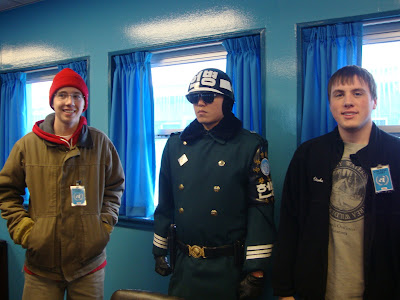
Here, Mike's in South Korea, while Tom's in North Korea.
We left the conference room after about 15 minutes of rapid-fire picture taking and went to a lookout point outside. During our march there, our ROK soilder/tour guide yelled at some people for falling out of line and not keeping up with the group! From the lookout point, we could see the North's main JSA building as well as a skeptic KPA guard looking at us through binoculars. I took a few pictures of him looking at us. We could also somewhat see the North's propoganda village in the distance, but it was still cloudy and snowy so those pictures aren't the greatest. We were allowed to stay on the lookout for about 15 minutes, then we marched back to the bus.
These are the conference buildings, we went in the center one:
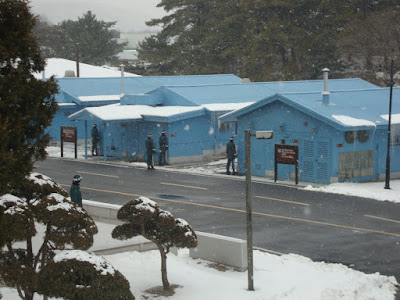
This is North Korea, do you see the soilder?

That was pretty much it for the JSA tour, and we then drove back though the DMZ and through Camp Bonifas on the way back to Seoul. I was impressed at the amount of barbed wire fences on the way out, even after we'd left the DMZ area. Oh, I forgot we did stop at the Camp's souvenier shop and switched back to our bus where we'd left our things. Also, as I mentioned earlier, we were able to keep our disclaimer we signed upon arrival. I think it was partly because someone in our group asked to and partly because we were the only visitors there. I'd say we were lucky that we chose to go on that day of all days!
It was a full day tour, we got back to the Lotte Hotel around 5:30 just as the sun was starting to go down and the Christmas lights were coming on. It was a great tour, and I'd definitely recommend the company. Just make sure you get to do both tours (DMZ and JSA), if I'd only done one part, I wouldn't have been completely satisified with my tour. And, I was also relieved that we didn't encounter any "hostile enemy action!"
More pictures:
http://www.facebook.com/#/album.php?aid=2220653&id=59501140&ref=mf


